Category Archives: Community Building
Talking Politics on FPF – Finding the “Shared Middle”
Cara in the Town of Halifax recently posted the following on her local Front Porch Forum when a neighbor suggested banning political speech on FPF. We love her perspective on this. Read on…

Some postings on FPF concern politics at every level – local (like the 5-person board discussion), state (Article 22) and national (names of parties). FPF *is* a place to have these discussions – there is, after all, a standard category called “election.”
The people in our small communities all share certain values – the ones that lead people who were born here to stay and that lead people who weren’t born here to make it their home.
But we don’t all share the same views, not by a long stretch. The value of FPF is that it makes it possible to find common ground and discover you like or respect people despite the fact that you may wildly disagree on issues.
That’s missing in so many parts of our lives. Let’s not strip it out of FPF, too.
I’ll recommend an episode of the podcast Revisionist History to illustrate the point. It’s hosted by Malcolm Gladwell (FN: If you don’t like him, no worries – I never did before either but it’s a terrific podcast, not glib like so much of his writing). The episode is called “When Will Met Grace” (FN: if you never liked the show, no worries – I never did either but the episode made me appreciate it). Gladwell notes that the show was hated by ultra conservatives and ultra progressives alike. But the show was on one of the four TV networks we all watched, and that resulted in it having a demonstrably moderating effect on private lives and on the national conversation.
Unfortunately, it’s so easy to avoid these days. Nowadays, people think they’re achieving that same goal by watching both Fox News and MSNBC, or reading the Wall Street Journal and the Washington Post. But consuming two extremes isn’t the same as consuming something shared in the middle.
That’s why I love FPF. It doesn’t permit anonymous posts. It’s limited to folks who have planted themselves in a small geographic area. And, most importantly, it caters to everything from lost cats to roofer recommendations to crime reports to asking for help to stack wood to, yes, politics. I like that it’s everything – because in that way, it has the capacity to have a moderating effect on all of our lives in all sorts of ways. I know for a fact that it’s helped me forge a sense of connection and community with people I wouldn’t otherwise have had an opportunity to meet or know if we all veered off into our political silos. Knowing that we have such wildly divergent views on things is important because it’s part of what makes the connection so valuable and ultimately, gives me hope.
We can only control our own conduct. If I don’t jibe with a particular person in the community or with certain views and it bothers me to see some posts? The answer isn’t to tell people to be quiet. The answer is for me to decide I don’t want to listen. But I do listen and I know from personal experience that my world is richer as a result.
I hope everyone will feel free to keep posting and keep all of these conversations going. I agree there’s no room here for hateful political or personal attacks, but just because a view is expressed that one doesn’t agree with doesn’t make it hateful.
One Vermonter’s Response to Inflation
A recent Front Porch Forum posting in the Northeast Kingdom…
My favorite shopping place is FPF. As we are all struggling to get by, we think we can’t afford to buy what we need. But then the generosity of an FPF neighbor comes through. They have helped me several times! Thank you Neighbors 🤗
• Randall in East Burke
Clearing the garage…

Sometimes you need just a little bit of something to finish one small project. For this neighbor, it was leftover paint.
Thanks to everyone who donated spray paint for my small projects! What a great way to get rid of unused paint cans. If people are clearing out their garages, consider posting things like this. There’s always someone with a half-finished project that could use your unwanted paint/nails/scraps of wood/etc. What a great forum we have here!
•Catharine in Brandon
More than Just a Garden Cart
What a lovely reflection of FPF’s use in this recent posting:

Need fulfilled, money saved, carbon footprint reduced, and neighbor connection created.
Many thanks for all the suggestions and offerings regarding my query about getting myself another Garden Way Cart. Mine lasted 43 years, and doesn’t owe me a thing, but is now saying “goodbye” by falling apart. Thanks to Donna, I now have an even larger cart that will allow me to get garden jobs done just that much faster. When hubby and I went to pick up the cart, we had a nice time chatting as a thunderstorm rolled in! It’s nice to get to know our neighbors and also nice to not have to shell out full price for something new when something used is right near by! Thank you!! • Devin in Grand Isle
A Big Shout Out to Local Business
A recent posting to the Williston Forum by FPF member Jeff:
I would like to take a minute to say thank you to Corey and Jake at JC Property Management.
On a recent early Sunday morning, on our way to go to a ski race at Sugarbush, we stopped at a parking lot in Hinesburg to grab something out of the back of our Suburban. Unknown to me, one of our bags fell out of the back. When we got to Sugarbush, we discovered the bag was missing.
After getting home and not finding the bag, we realized what had happened. After driving back to check the parking lot, we called the Police hoping someone turned it in. We also posted on Front Porch Forum. That was the best thing we did.

About a week later I received a call from Kory. He and his partner had found the bag while plowing that snowy morning. He had been searching for the owner. But, there was no identification tags on the bag. He was told by a friend to look on FPF.
Thankfully, he did. We were reunited with the bag. We had offered a reward for the safe return of the bag. Kory would not take the reward. He was just doing a good deed.
I want to thank Kory and the guys at JC Property Management. They are really good, honest guys. If you need work done at your property, I highly recommend giving them a call.
A Kinder, Gentler Social Network
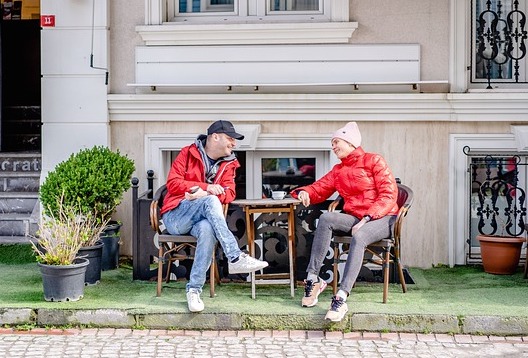
Big Tech and social media giants are under the microscope more than ever. Front Porch Forum continues to draw attention from news outlets as the more friendly alternative among sites that are meant to connect us.
Julia Angwin, Editor-in-Chief of The Markup, a popular publication investigating Big Tech, recently spoke with FPF’s co-founder Michael Wood-Lewis to learn more about how FPF keeps conversations neighborly and kind, while other social media sites seem to be losing civility.
Read the full interview here.
Healthy Digital Discourse
The Aspen Institute just issued its Commission for Information Disorder final report. We’re humbled to see Front Porch Forum recognized among a short list of approaches that are making real progress instead of feeding the spread of disinformation. The commission includes celebrities like Craig Newmark, Katie Couric and Prince Harry, along with an array of national experts.
FPF was held as an example of how to
“Develop and scale communication tools, networks, and platforms that are designed to bridge divides, build empathy, and strengthen trust among communities.“
An Evening of Courageous Conversations
On November 18, FPF participated in a virtual event celebrating Vermonters taking One Small Step. VPR and StoryCorps have spent the last several months connecting residents with different views who might never talk otherwise for a simple, personal conversation. Hear voices from the project followed by an interactive conversation with participants and experts, including Front Porch Forum’s co-founder Michael Wood-Lewis. Learn about the project’s intentions and how to incorporate “courageous conversations” into our daily lives. Listen to the show here.

Front Porch Forum and Braver Angels joined the panel to share how we help facilitate these conversations, build community and provide the tools to do have these conversations.
Healthy Social Media? Experts Weigh In

Vermont’s own example of “Small Tech,” Front Porch Forum, drew several mentions this past week as the antithesis of Facebook and other destructive Big Tech.
Michelle Goldberg stated in the New York Times:
“Deb Roy, director of the M.I.T. Center for Constructive Communication and former chief media scientist at Twitter,… believes that the potential for a healthy social media exists — he points to Front Porch Forum, the heavily moderated, highly localized platform for people who live in Vermont. But it’s notable that his best example is something so small, quirky and relatively low-tech. Sure, there are ways of communicating over the internet that don’t promote animosity, but probably not with the platforms that are now dominant.“
While Jason Kelley and Danny O’Brien at the Electronic Frontier Foundation shared…
“[FPF] users say that while most of the internet ‘is like a fire hose of information and communication, Front Porch Forum is like slow drip irrigation.’ While many of the most popular social networks need to scale to perform for investors, which relies on moving fast and breaking things, Front Porch Forum could be described as a site for moving slowly and fixing things.”
And civic tech expert Micah Sifry said in his SubStack newsletter The Connector…
“Ian Bogost makes a good argument in The Atlantic for legislators or regulators setting speed and volume limits on sites like Facebook. Getting the tuning right won’t be simple, but in the same way that we’ve come up with safety rules for all kinds of products, we need them for social media. I’d start by looking at what has worked for a platform like Front Porch Forum, and try limiting the size of people’s ‘friend’ lists and the speed of comments.”
FPF to Speak on Panel: Reimagine the Internet

Detail of Civic Logic, by Fiammetta Ghedini, RIVA Illustrations
Front Porch Forum‘s co-founder, Michael Wood-Lewis, will speak on a panel for the virtual conference, Reimagine the Internet, on Thu., May 13 at 12:00 p.m. The event is co-hosted by the Knight First Amendment Institute at Columbia University and the soon-to-be-launched Initiative on Digital Public Infrastructure at the University of Massachusetts, Amherst.
FPF will be joined by many notable panelists, including Cory Doctorow of Electronic Frontier Foundation, Evelyn Douek of Harvard Law School and Katherine Maher of Wikimedia Foundation.
Front Porch Forum will be part of Thursday’s discussion:
Lessons from Experiments in Local Community-Building
Thursday, May 13, 2021
12:00 p.m. – 1:30 p.m.
This panel will focus on lessons learned from local communities and the implications of these lessons for online spaces. Sara Lomax-Reese is the CEO of WURD, a family-owned talk radio station in Philadelphia that serves that city’s Black community. Michael Wood-Lewis is co-founder of Front Porch Forum, an online community of mailing lists that serves every town in Vermont. Individually and in dialog, both will address lessons learned in building hyperlocal media and the ways in which online communities build trusted relationships.
Panelists
- Sara Lomax-Reese, WURD Radio
- Michael Wood-Lewis, Front Porch Forum
Moderator
- Ethan Zuckerman, Initiative on Digital Public Infrastructure at the University of Massachusetts, Amherst; Knight First Amendment Institute at Columbia University
Learn more about the virtual conference or RSVP here.
About Blog
Ghost of Midnight is an online journal about fostering community within neighborhoods, with a special focus on Front Porch Forum (FPF). My wife, Valerie, and I founded FPF in 2006... read more
Post Categories
- Uncategorized
- PDF2009
- Calendar
- podcast
- Northeast Kingdom
- Peer Rental
- Big Tech
- Localization
- Events
- Google AdSense
- Web Traffic
- PDF2007
- Elections
- Pay It Forward
- berkmansunlight
- Maps
- Video
- Upstate New York
- Mobile
- Coupons
- Wildlife
- Raffle
- Viral Marketing
- Donations
- Crisis Response
- Lost & Found
- Gratitude
- College Students
- Real Estate
- Social Responsibility
- Orton Family Foundation
- Start ups
- Make It Your Own Awards
- Online Civility
- Clay Shirky
- Newspapers
- Humor
- How To Use FPF
- Online Classified Ads
- Peer Reviews
- Politics
- Community Management
- Best of FPF
- Economic Development
- Local Reviews
- Case Foundation
- Borrow and Lend
- Neighborhood Watch
- Good Government
- Small Business Advertising
- Citizen Journalism
- e-Vermont
- Democracy
- Local Search
- Knight Foundation
- Burlington
- MacArthur Fellows
- Civic Engagement
- Social Media
- social capital
- Social Networking
- Vermont
- Neighborhood
- Community Building
- Local Online
- Front Porch Forum