Category Archives: Twitter
Fixing Digital Public Spaces

Leslie Stebbins was quoted in a recent Salon article, “Our digital public spaces aren’t so healthy… Can we fix that?” (read full article here) that…
“Tech companies maintain that they cannot moderate online communities because that would jeopardize our right to free speech and because there is simply too much content flying across these networks to track. Both these issues are false flags. We now know that the core infrastructure of these platforms is intentionally designed to amplify vitriol and misinformation because this increases engagement, keeps us online longer, and provides tech companies with billions of dollars from ad revenue. It doesn’t have to be this way.“
Further, Stebbins adds, “We should focus on creating new spaces that have explicit civic goals and are designed for equity and social cohesion. Real-world communities need to be involved in intentionally designing their own local digital public spaces rather than leaving this work to global tech companies.”
Front Porch Forum gets a nice spotlight in the article…
“Front Porch Forum […] focuses on real world community building. It is the antithesis of Facebook, TikTok, and Twitter. Rather than try to keep users online, it strives to get people offline and more connected to their local Vermont neighbors. Most people spend five or ten minutes a day online to get news that their neighbors have posted: lost dogs, bake sales and announcements of upcoming school board meetings. It is funded by donations and local ads based on where someone lives, but it does not track user behavior and advertising does not drive platform design.“
“Independent research on Front Porch [Forum] shows that it builds social cohesion and is improving the resilience of local Vermont communities. Building stronger community cohesion produces many intangible benefits such as high civic engagement, more instances of neighbors helping neighbors, and lower crime rates.“
Going on a Bear Hunt
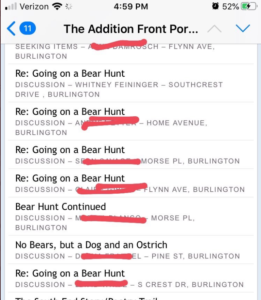
“This just makes me so happy. My @frontporchforum has never seen this much action.” • Whitney in Burlington
Front Porch Forum members are creating local scavenger hunts. The popular “Bear Hunt” is fun for kids. Neighbors put teddy bears (and other stuffed animals) in their own windows for children to spot when they walk or ride around their neighborhoods.
“Would folks like to create a bear hunt? We will definitely have some bears in our windows and are curious if other neighbors would like to join in the “hunt”. Members of a number of communities across the globe are placing teddy bears and other stuffed animals in their homes’ windows to create a scavenger hunt-esque activity for kids who are stuck at home. While taking walks or drives around the neighborhood with their parents, kids in participating communities can have some fun by keeping an eye out for any number of stuffed animals that have been put on display at other houses.” • Judy in Burlington
Start one in your neighborhood with a post on FPF!
Finding Housing in Vermont
 FPF member, Katie G., tweeted this great tip for finding housing on Front Porch Forum:
“A thing I love about Vermont: on it’s face, renting is hard (especially w/a dog), but if you put a post about yourself up on Front Porch Forum (i.e. pretty much send a personal ad about yourself to the whole town), tons of people will reach out with unadvertised housing opps!”
What are you waiting for? Reach out to your neighbors on FPF today!
“Skepticism about ‘online community’?”
From Harvard’s Social Capital Blog…
State of the Re:Union looks at online communities
 #BTV #VT – This NPR show weaves together several stories about online communities… lots of food for thought, including a segment about Front Porch Forum (for FPF’s part, go to the 5th section (Segment B) and start at the 7:00 minute mark).
Emergent Media for Social Entrepreneurs and Nonprofits in Waitsfield #VT July 12
New/Digital Emergent Media for Social Entrepreneurism and Nonprofits
HigherMind Mediaworks to host free July NetsquaredVermont Event
@ Quench ArtSpace in Waitsfield on Thursday, July 12 from 7:00 – 9:00 pm
Curious about Front Porch Forum? Yakking on YouTube? Friending on Facebook? Tweeting on Twitter? All Mad River Valley residents interested in new digital media platforms and how they can be harnessed for effective social entrepreneurism and nonprofit work are invited to a FREE public forum bringing together some of Vermont’s most forward-thinking nonprofit leaders and social entrepreneurs using new/digital emergent media for positive social change.
Our July 12 @Netsquared guest panelist presenters include:
• Lauren Glenn-Davitian and Eli Harrington, who spearheads CommonGoodVT, a Burlington-based organization dedicated to supporting the Vermont nonprofit community. Connect @ www.commongoodvt.org.
• Michael Wood-Lewis, the co-founder of Front Porch Forum, a free community-building service helping neighbors connect, now being used in dozens of towns around Vermont. Network @ frontporchforum.com.
• Sandy Tarburton, Membership and Communications Director for the Northern Forest Canoe Trail. Paddle @ www.northernforestcanoetrail.org.
• Amanda Levinson, pioneering organizer of @Netsquared in Vermont, who founded the Burlington @Netsquared chapter this past winter. Get squared @ www.netsquared.org.
Extra bonuses? Free food, drink, contemporary art, and the crowd sourced wisdom of your friends and neighbors!
Thanks to our food co-sponsor Liz Lovely Cookies of Waitsfield.
See you @ Quench ArtSpace in Waitsfield on Thursday, July 12 @ 7:00 pm. [Thanks to Rob Williams for sharing this announcement and for organizing!]
Burlington community engagement survey results
 #BTV #VT – Burlington’s Community and Economic Development Office (CEDO) just released the results of a new survey that shows that “sense of community” is highly valued by Burlington citizens. About 44% liked their neighborhood because of friendly neighbors and a strong sense of community. And 10% said that an even stronger sense of community would improve their neighborhood more.
The average respondent (588 total) uses Front Porch Forum, is an English-speaking homeowner age 30 to 60, lives with one other adult and no children, works full-time, and has an annual household income greater than $50,000.
Some other tidbits…
Q: How did you find out about your Neighborhood Planning Assembly?
38% Front Porch Forum
22% Word of mouth
5% Newspaper
35% Other
Q: What do you like about your neighborhood?
52% Proximity to amenities
44% Friendly neighbors/strong sense of community
Lots of other options
Q: What would you change about your neighborhood?
13% Less traffic and speeding
11% Nothing
10% More connection to neighbors
Lots of other options
Q: Are you subscribed to Front Porch Forum?
93% Yes
Q: Which (other) social media do you use?
92% Email
69% Facebook
33% YouTube
21% Twitter
17% Google+
4% None
1% LinkedIn
Several others listed
Q: How did you find out about survey?
69% Front Porch Forum
10% CEDO e-newsletter
4% NPA
4% Friend/co-worker
3% Facebook
2% email
2% Bulletin board
1% Twitter
1% Service provider
0.2% Business
Q: Languages spoken in household?
99% English
6% French
4% Spanish
16 other languages selected by respondents
Q: Rent or own your housing?
30% Rent
70% Own
Q: Number of adults (18 or older) living in household?
20% 1
66% 2
9% 3
3% 4
1% 5
0.4% 6-7
Q: Children under 18 in household?
68% 0
14% 1
14% 2
2% 3
1% 4
Q: Your age?
1% Under 18
18% 18-29
34% 30-44
32% 45-61
13% 62-74
3% 75 and over
Q: Your employment?
58% Work full-time
16% Work part-time
11% Retired
5% Student full-time
4% Unemployed
2% Self-employed
1% Disabled
1% More than 1 job
1% Attending school and working
1% Stay-at-home parent
0.4% Student part-time
0.2% Sabbatical
Q: Your annual household income?
13% Less than $20,000
12% $20,000 to $30,000
10% $30,000 to $40,000
10% $40,000 to $50,000
14% $50,000 to $65,000
9% $65,000 to $80,000
15% $80,000 to $100,000
15% More than $100,000
I share, therefore I am — Alone Together
From the Sunday New York Times yesterday, by Sherry Turkle, author of “Alone Together: Why We Expect More From Technology and Less From Each Other“…
We live in a technological universe in which we are always communicating. And yet we have sacrificed conversation for mere connection.
At home, families sit together, texting and reading e-mail. At work executives text during board meetings. We text (and shop and go on Facebook) during classes and when we’re on dates. My students tell me about an important new skill: it involves maintaining eye contact with someone while you text someone else; it’s hard, but it can be done.
Over the past 15 years, I’ve studied technologies of mobile connection and talked to hundreds of people of all ages and circumstances about their plugged-in lives. I’ve learned that the little devices most of us carry around are so powerful that they change not only what we do, but also who we are…
Which reminds me of a favorite quote…
Sow an act, and you reap a habit.
Sow a habit, and you reap a character.
Sow a character, and you reap a destiny.
– Charles Reade, 19th century writer
What acts and habits are we developing now with all this mobile technology? And does it add up to changes in our individual characters and destinies?
From a comment writer on the Times op-ed…
A few weeks ago, while having breakfast in a crowded restaurant, I was pleasantly surprised to note that a family of 4 across the room was saying Grace before starting their meal. Until my daughters pointed out that Dad, Mom, Sis and Junior were bowing their heads in front of their untouched meals because each one of them was furiously tapping the phones on their laps.
Unlike many online providers, Front Porch Forum does not want to keep its members transfixed to their screens for eight, 12 or 18 hours per day. Rather, we aim for five minutes of daily news and conversation from and with nearby neighbors. We aim to help people better connect with their actual neighbors and take up conversations… not online, but on the sidewalk, grocery check-out, and school playground.
From Turkle again…
When people are alone, even for a few moments, they fidget and reach for a device. Here connection works like a symptom, not a cure, and our constant, reflexive impulse to connect shapes a new way of being.
Think of it as “I share, therefore I am.” We use technology to define ourselves by sharing our thoughts and feelings as we’re having them. We used to think, “I have a feeling; I want to make a call.” Now our impulse is, “I want to have a feeling; I need to send a text.”
So, in order to feel more, and to feel more like ourselves, we connect. But in our rush to connect, we flee from solitude, our ability to be separate and gather ourselves. Lacking the capacity for solitude, we turn to other people but don’t experience them as they are. It is as though we use them, need them as spare parts to support our increasingly fragile selves.
We think constant connection will make us feel less lonely. The opposite is true. If we are unable to be alone, we are far more likely to be lonely. If we don’t teach our children to be alone, they will know only how to be lonely.
Does Facebook make you sick?
 Stephen Marche writes in The Atlantic Magazine (May 2012)…
Social media from Facebook to Twitter have made us more densely networked than ever. Yet for all this connectivity, new research suggests that we have never been lonelier (or more narcissistic) and that this loneliness is making us mentally and physically ill. A report on what the epidemic of loneliness is doing to our souls and our society.
Vermonters have many choices…
 #VT – Lots of great discussion of various online tools today at the e-Vermont workshop in Randolph. I was blown away by first-hand accounts of Moretown citizens responding to Hurricane Irene, as well as the folks of Westford self-organizing a food shelf to help neighbors in need.
Vermonters have so many digital media tools in the toolbox from which to choose. That said, I’m partial to our Front Porch Forum for many applications. Apparently Doris in Argyle, NY feels the same way (from her current posting)…
Thanks to everyone who posted or emailed info about the Pleasant Valley public hearings, which my husband will attend tonight. I was pleased to see that Front Porch Forum published the info in a timely manner.
It occurs to me that one week of following FPF has given me more positive information and ideas than several years of trying to negotiate Facebook. With Facebook I have struggled to figure out who is seeing what information and I have not gleaned much of anything from a world of “friends” except for gossip and a lot of negative interaction. So, goodbye Facebook, and hello Front Porch Forum!
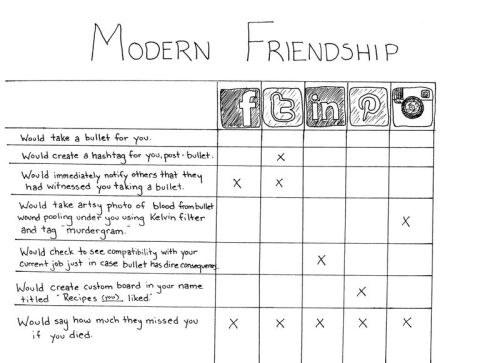
And I’d be remiss if I didn’t share this bit about Twitter… just in fun, of course…

Update: And from Carrie in Argyle…
Doris, I agree…been thinking the same thing about getting rid of facebook. I love that the FPF news I hear is local!!! I feel so much more connected.
About Blog
Ghost of Midnight is an online journal about fostering community within neighborhoods, with a special focus on Front Porch Forum (FPF). My wife, Valerie, and I founded FPF in 2006... read more
Post Categories
- Uncategorized
- PDF2009
- Calendar
- Northeast Kingdom
- podcast
- Peer Rental
- Localization
- Big Tech
- Events
- PDF2007
- Web Traffic
- Google AdSense
- Pay It Forward
- Elections
- berkmansunlight
- Maps
- Video
- Upstate New York
- Coupons
- Wildlife
- Mobile
- Viral Marketing
- Raffle
- Crisis Response
- Donations
- Lost & Found
- Gratitude
- Real Estate
- College Students
- Social Responsibility
- Orton Family Foundation
- Start ups
- Best of FPF
- Make It Your Own Awards
- Online Civility
- Clay Shirky
- Newspapers
- How To Use FPF
- Humor
- Online Classified Ads
- Peer Reviews
- Politics
- Community Management
- Economic Development
- Local Reviews
- Case Foundation
- Borrow and Lend
- Neighborhood Watch
- Good Government
- Small Business Advertising
- Citizen Journalism
- e-Vermont
- Democracy
- Local Search
- Knight Foundation
- Burlington
- MacArthur Fellows
- Civic Engagement
- Social Media
- social capital
- Social Networking
- Vermont
- Neighborhood
- Community Building
- Local Online
- Front Porch Forum