Category Archives: Social Networking
Community-building chorus in Winooski
An uplifting story from Matt Sutkoski at the Burlington Free Press today…
The city of Winooski needed more music, more songs, Maria Rinaldi decided earlier this year.
At about the same time, the same thought crossed the mind of Sister Pat McKittrick of the Sisters of Providence. “I wanted something to lift spirits and bring people to the community. I really believe music is healing,” she said.
The two women’s thoughts culminated recently in the inaugural concert of the Winooski Community Chorus. About a dozen chorus members entertained about 125 people Dec. 6 at the Sisters of Providence chapel. McKittrick said that was many more people than expected…
McKittrick and Rinaldi recruited chorus members by posting messages on Front Porch Forum and in church bulletins and by talking the chorus up to friends and relatives…
Maria Rinaldi

Serving your nation, your community or your neighborhood
Craig Newmark writes in the Huffington Post today…
Deep in the Barack Obama platform, there’s a reference to “a craigslist for service.” It’s humbling to see our name in there, but I’d prefer to see that as only a metaphorical reference to the need for greater service to others, with the spirit and culture of trust of craigslist. Obama is inspiring millions of people to consider service to others, and to innovate for service. Check out what Barack says at change.gov
“When you choose to serve — whether it’s your nation, your community or simply your neighborhood — you are connected to that fundamental American ideal that we want life, liberty and the pursuit of happiness not just for ourselves, but for all Americans. That’s why it’s called the American dream.”
Sounds like a description of how many folks use Front Porch Forum.
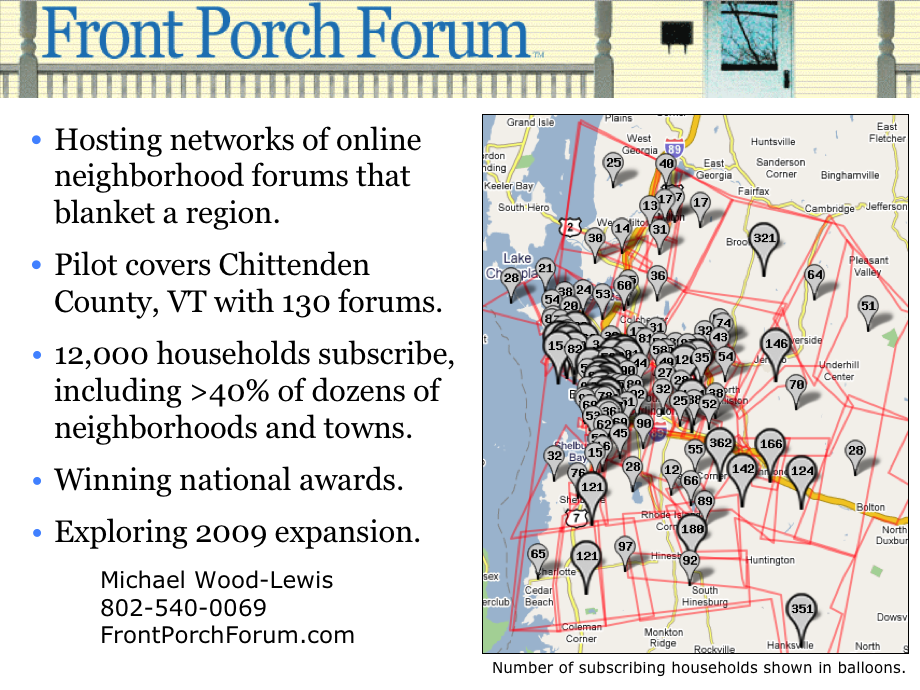
Front Porch Forum in Two Slides
Here’s Front Porch Forum boiled down to two slides…

Lessons for Social Software
I’ve admired Clay Shirky‘s work since first meeting him a couple years ago at a Personal Democracy Forum. Somehow though, I had missed his excellent 2003 piece “A Group is Its Own Worst Enemy.” So thanks to Rich Gordon for pointing to it this week.
Clay’s speech lays out commonalities across social software, pulling lessons from the past few decades… and pre-Web 2.0 explosion. It reads, to me, like a text book version of the lessons we’ve learned “the hard way” in hosting Front Porch Forum.
My wife, Valerie, and I started FPF in 2000 as a stand-alone online neighborhood forum. We leaned on our neighbors to help us develop the rules of engagement… some firm (e.g., no anonymity), others soft (like a generally civil and constructive tone). In 2006, we launched a network of 130 online neighborhood forums blanketing our pilot area of Chittenden County, VT, and continued to evolve our rules based largely on member feedback.
Some of Clay’s points from 2003 that strike a chord…
So there’s this very complicated moment of a group coming together, where enough individuals, for whatever reason, sort of agree that something worthwhile is happening, and the decision they make at that moment is: This is good and must be protected. And at that moment, even if it’s subconscious, you start getting group effects. And the effects that we’ve seen come up over and over and over again in online communities.
He cites some research too about groups defeating their own purpose by veering off course… three patterns…
Sex talk… the group conceives of its purpose as the hosting of flirtatious or salacious talk or emotions passing between pairs of members
Identification and vilification of external enemies
Religious veneration. The nomination and worship of a religious icon or a set of religious tenets… something that’s beyond critique.
And…
You can find the same piece of code running in many, many environments. And sometimes it works and sometimes it doesn’t. So there is something supernatural about groups being a run-time experience. The normal experience of social software is failure. If you go into Yahoo groups and you map out the subscriptions, it is, unsurprisingly, a power law. There’s a small number of highly populated groups, a moderate number of moderately populated groups, and this long, flat tail of failure. And the failure is inevitably more than 50% of the total mailing lists in any category.
Clay’s tips for developing and running social software…
- You cannot completely separate technical and social issues
- Members (“super users”) are different than users
- The core group has rights that trump individual rights in some situations (serve the group over the individual)
- Design for handles (similar to identity) that the user can invest in
- Design some way in which good works get recognized
- You need barriers to participation. You have to have some cost to either join or participate, if not at the lowest level, then at higher levels. There needs to be some kind of segmentation of capabilities.
- Find a way to spare the group from scale. Scale alone kills conversations, because conversations require dense two-way conversations.
Easy communication among neighbors a right?
John Wonderlich at Sunlight Foundation quotes Steven Clift today…
When I was a child and my father had cancer, I remember neighbors coming to our assistance in our time of need. Today, with modern life keeping neighbors as strangers, we must use these new tools to break down barriers to community. You deserve the right to easily e-mail your immediate neighbors the morning after you’ve been burglarized without having to go door-to-door to collect e-mail addresses. We can balance safety and privacy with selective public disclosure of such personal contact information with an intelligent “unlisted to most” directory option that is not the all or nothing of today.
This is big “C” community and small “d” democracy. A collection of better-connected blocks, tied to broader neighborhood and community-wide online efforts will serve as the vibrant foundation we need for accountable and effective representative democracy right up to the Congress and president. You cannot force everyone to be neighborly, but the bonds of community can be restored and nurtured despite dual income families and the assault on time for community involvement.
Right on. We’re honored that they both mention Front Porch Forum. And thanks to The Pulse from the Knight Foundation for pointing me to this post.
About Blog
Ghost of Midnight is an online journal about fostering community within neighborhoods, with a special focus on Front Porch Forum (FPF). My wife, Valerie, and I founded FPF in 2006... read more
Post Categories
- Uncategorized
- PDF2009
- Calendar
- podcast
- Northeast Kingdom
- Peer Rental
- Big Tech
- Localization
- Events
- Google AdSense
- Web Traffic
- PDF2007
- Elections
- Pay It Forward
- berkmansunlight
- Maps
- Video
- Upstate New York
- Mobile
- Coupons
- Wildlife
- Raffle
- Viral Marketing
- Donations
- Crisis Response
- Lost & Found
- Gratitude
- College Students
- Real Estate
- Social Responsibility
- Orton Family Foundation
- Start ups
- Make It Your Own Awards
- Online Civility
- Clay Shirky
- Newspapers
- Humor
- How To Use FPF
- Online Classified Ads
- Peer Reviews
- Politics
- Community Management
- Best of FPF
- Economic Development
- Local Reviews
- Case Foundation
- Borrow and Lend
- Neighborhood Watch
- Good Government
- Small Business Advertising
- Citizen Journalism
- e-Vermont
- Democracy
- Local Search
- Knight Foundation
- Burlington
- MacArthur Fellows
- Civic Engagement
- Social Media
- social capital
- Social Networking
- Vermont
- Neighborhood
- Community Building
- Local Online
- Front Porch Forum