Category Archives: Social Networking
Hiding in Plain Sight
Vermont Public Radio commentator Andrea Learned chimed in today with a piece called “Sustainable Waldo.”
I’ve been thinking a lot lately about how to nudge more people toward sustainable living practices. While switching out light bulbs and recycling as much as possible are both easy ways to start that process, what comes next? … we may now need to focus on places where sustainability is hidden in plain sight… Remember the “Where’s Waldo” books? Darned if he wasn’t right in front of your nose and you didn’t see him. So where are some sustainability Waldos?
One great example might lie in urban density and community transportation planning issues… Gardening is another activity where sustainability may be hiding in plain sight.
And what about neighborhood involvement, as supported by services like Vermont’s own Front Porch Forum, which host networks of online neighbor-to-neighbor help and information. Communities built on stronger interpersonal relationships and citizen interconnections help build more long-term, sustainable views on big, challenging issues. Whether or not citizens see this as sustainability doesn’t really matter. They are responding to powerful, sustainability-promoting, shared values.
She’s got a point! Sometimes we talk about FPF’s larger community benefits… but most of the time when chatting with folks, we focus on the direct and obvious benefits… use FPF to find an affordable plumber or ride to Boston, to report a car break-in to neighbors, to sell a bike or give away a stroller.
Cities, neighborhoods, community and Jane Jacobs
Convergence from my reading pile…
- Richard Florida: Who’s Your City: How the creative economy is making where to live the most important decision of your life, 2008.
- Jonah Lehrer, NYTimes Magazine, A Physicist Solves the City, Dec. 19, 2010.
- John McKnight and Peter Block: The Abundant Community: Awakening the Power of Families and Neighborhoods, 2010.
Each author talks about cities and neighborhoods, and residents’ decisions about where to live and how to live within their communities. They all reference Jane Jacob‘s pioneering work in community and urban planning. And each is well worth reading.
The Times article examines the research of Geoffrey West who is developing equations that he claims describe cities… parallel to the laws of physics. E.g., “whenever a city doubles in size, every measure of economic activity… increases by 15 percent per capita.” Which leads to the idea that moving a person to bigger and bigger cities will make her more and more economically productive.
Richard Florida’s book is full of interesting survey data. Take a look at his maps. Here’s a sample…

Finally, the most compelling and visionary of the lot to this reader is The Abundant Community. McKnight and Block, from a lifetime of experience lay out their case for “a new possibility for each of us to live a more satisfying life” by joining “our neighbors to live and create a community that nurtures our family and makes us useful citizens.” Lots of tactics and examples placed in a useful framework. Many neighborhoods and rural towns in Vermont are using Front Porch Forum in this way and it’s beautiful to behold.
Feelings lead to action
Richard Millington’s post today got me thinking…
Feelings provoke actions… Focus on making members feel more engaged, not act more engaged.
Many times a day, Front Porch Forum pilot members are moved to be more engaged in FPF… and, more importantly, many are move to be more engaged in their actual/non-virtual neighborhood. This is often brought about by feelings elicited by an FPF posting from a neighbor.
Here are two key references from Millington…
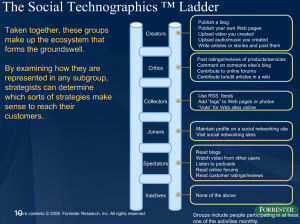
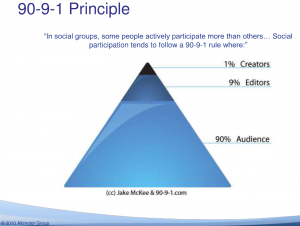
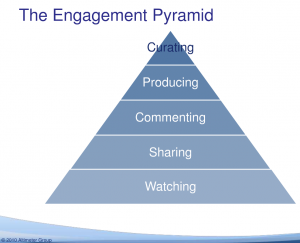
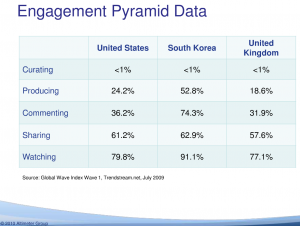
You’ve probably come across the technographics ladder or the socialgraphics engagement pyramid. These categorize members by their actions. Lurkers are at the bottom, creators at the top. Sharing, reading, tagging are in-between.
First, the technographics ladder…
And the socialgraphics engagement pyramid…
Mark Suster on Social Networking
Entrepreneur and venture capitalist Mark Suster open his blog post today with …
What I want to answer with this post (long though it may be) is:
- Why did Web 2.0 emerge and are there any lessons to be gained about the future? [cheap accessible digital hardware]
- Why did Twitter emerge despite Facebook’s dominance? [asymmetry, real-time, curated RSS / link-sharing]
- Why did MySpace lose to Facebook & what can Twitter learn from this? [encouraging an open platform where 3rd parties can make lots of money]
- Does Facebook have a permanent dominance of the future given their 500m users? [chuckle. ask microsoft, aol/time warner & google]
- What are the big trends that will drive the next phase of social networks? [mobile, locations, layering of services, data management, portability & more]
An excellent piece… worth the whole read. Shortened version here… and full version here.
New study: Neighborhood websites build community and get people involved
Congratulations to UK’s Hugh Flouch and Kevin Harris on the publication of the results of their new study…
Do neighbourhood websites have a positive social impact locally? For those who’ve suspected and long wanted convincing evidence, we think the wait is over.
The report of the Online neighbourhood networks study was launched yesterday during a lively conference in London…
Our study looked at three neighbourhood sites in London. The research shows that they serve to enhance the sense of belonging, democratic influence, neighbourliness and involvement in their area. Participants claim more positive attitudes towards public agencies where representatives of those agencies are engaging online.
We’ve produced a short (4-page) summary, an extended summary, a full report divided into digestible chunks, a selection of video interviews, together a number of other papers, and we will continue to add to these.
We see similar trends with Front Porch Forum in our pilot region. That is, FPF members report… (1) better connection to neighbors and neighborhood, (2) a more prominent voice in local decision-making, (3) a friendlier environment, and (4) increased civic engagement.
Miscellaneous findings from the UK report…
95% – Feel more informed about neighborhood
92% – Neighbors are helpful if asked for advice
69% – Increased sense of belonging within neighborhood
92% – Useful information gets shared efficiently
82% – People pull together to improve neighborhood
63% – Main source of local news
44% – Neighbors more likely to lend items or exchange favors
42% – Met a neighbor
54% – More likely to see a neighbor you recognize due to website – Active member
14% – More likely to see a neighbor you recognize due to website – Passive member
This collection of materials is worth a close look!
Vermont Citizens in a Connected Age Workshop Dec. 11
The Citizens in a Connected Age workshop advances the computer and Internet skills learned through the Vermont State Colleges and Vermont Small Business Development Center courses offered in each e-Vermont project town.
However, ANY Vermonter with basic computer skills can attend this workshop!
Learn About
- Website communication tools.
- Social media – strategies for incorporating it into a business, government or personal life, with computer lab time.
- Troubleshooting technology – how to diagnose a problem with applications.
- Data security – backing up data, protecting private information.
- Marketing a business online.
- Google applications – why use Google apps, with computer lab time.
- Weighing the risks and benefits of online financial transactions.
- Digital storytelling for educators.
- Best practices for e-government websites.
When and Where
- Saturday, December 11, 2010
- 9:00 a.m. to 4:00 p.m.
- Castleton State College, Castleton, Vermont
- $10 registration fee – includes course offerings, refreshments and lunch.
- Options for online registration: pay by credit card online, or register online and pay at the door. We cannot accept credit cards at the workshop.
- Download the workshop poster (pdf).
For more information
Contact Joanna Cummings, e-Vermont Community Coordinator: joanna@snellingcenter.org
Visit
- The e-Vermont Community Broadband Project website: http://e4vt.org
- The Snelling Center’s e-Vermont website: http://www.snellingcenter.org/public-policy/e-vermont
About Blog
Ghost of Midnight is an online journal about fostering community within neighborhoods, with a special focus on Front Porch Forum (FPF). My wife, Valerie, and I founded FPF in 2006... read more
Post Categories
- Uncategorized
- PDF2009
- Calendar
- podcast
- Northeast Kingdom
- Peer Rental
- Big Tech
- Localization
- Events
- Google AdSense
- Web Traffic
- PDF2007
- Elections
- Pay It Forward
- berkmansunlight
- Maps
- Video
- Upstate New York
- Mobile
- Coupons
- Wildlife
- Raffle
- Viral Marketing
- Donations
- Crisis Response
- Lost & Found
- Gratitude
- College Students
- Real Estate
- Social Responsibility
- Orton Family Foundation
- Start ups
- Make It Your Own Awards
- Online Civility
- Clay Shirky
- Newspapers
- Humor
- How To Use FPF
- Online Classified Ads
- Peer Reviews
- Politics
- Community Management
- Best of FPF
- Economic Development
- Local Reviews
- Case Foundation
- Borrow and Lend
- Neighborhood Watch
- Good Government
- Small Business Advertising
- Citizen Journalism
- e-Vermont
- Democracy
- Local Search
- Knight Foundation
- Burlington
- MacArthur Fellows
- Civic Engagement
- Social Media
- social capital
- Social Networking
- Vermont
- Neighborhood
- Community Building
- Local Online
- Front Porch Forum