Category Archives: Local Online
Duping by the crowd vs. building community among neighbors
Greg Sterling blogged today (in part)…
The Sunday Times in the UK writes that Yell employees wrote 6,700 reviews for the site (TrustedPlaces) in a month for an internal contest. According to secondary reports:
Staff at the firm’s Reading HQ were encouraged to write reviews for the company’s website Trusted Places – a site boasting user-generated recommendations of places to visit – by the offer of prizes such as an iPad and Amazon vouchers, according to the Sunday Times.
The article and information are presented as something of an expose or scandal. However I don’t necessarily agree. If the reviews are real and authentic they’re not illegitimate in my mind. But it’s a close call…
Well… I’m not sure how 6,700 reviews written by paid staff for some kind of internal contest could be considered “real and authentic.” More importantly, this fuels a not uncommon suspicion that many online reviews are B.S. It’s just too easy to stack the deck with reviews from people who have a stake in the business being reviewed or in the host site itself.
We often hear from people who place a high value on reviews read on Front Porch Forum. They use terms like “real” and “authentic” because that’s what they are… postings from clearly identified nearby neighbors typically offered in response to a request from a neighbor… “can anyone recommend a good plumber?”
Also, each recommendation is seen by everyone in the neighborhood, not just those few who happen to be searching for a plumber. This leads to conversation among neighbors… sometimes on FPF, often via email, and even more commonly face-to-face.
So… a huge database of potentially bogus reviews from strangers… vs. a few reviews from clearly identified nearby neighbors that lead to conversations among neighbors on the sidewalk. Two different propositions.
Feelings lead to action
Richard Millington’s post today got me thinking…
Feelings provoke actions… Focus on making members feel more engaged, not act more engaged.
Many times a day, Front Porch Forum pilot members are moved to be more engaged in FPF… and, more importantly, many are move to be more engaged in their actual/non-virtual neighborhood. This is often brought about by feelings elicited by an FPF posting from a neighbor.
Here are two key references from Millington…
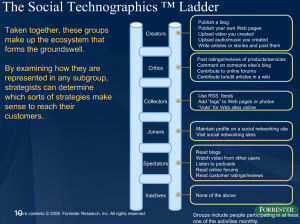
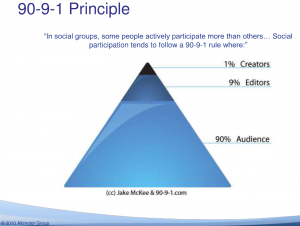
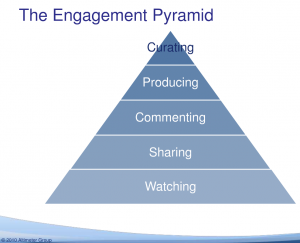
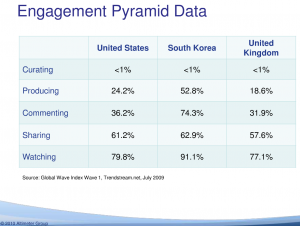
You’ve probably come across the technographics ladder or the socialgraphics engagement pyramid. These categorize members by their actions. Lurkers are at the bottom, creators at the top. Sharing, reading, tagging are in-between.
First, the technographics ladder…
And the socialgraphics engagement pyramid…
New study: Neighborhood websites build community and get people involved
Congratulations to UK’s Hugh Flouch and Kevin Harris on the publication of the results of their new study…
Do neighbourhood websites have a positive social impact locally? For those who’ve suspected and long wanted convincing evidence, we think the wait is over.
The report of the Online neighbourhood networks study was launched yesterday during a lively conference in London…
Our study looked at three neighbourhood sites in London. The research shows that they serve to enhance the sense of belonging, democratic influence, neighbourliness and involvement in their area. Participants claim more positive attitudes towards public agencies where representatives of those agencies are engaging online.
We’ve produced a short (4-page) summary, an extended summary, a full report divided into digestible chunks, a selection of video interviews, together a number of other papers, and we will continue to add to these.
We see similar trends with Front Porch Forum in our pilot region. That is, FPF members report… (1) better connection to neighbors and neighborhood, (2) a more prominent voice in local decision-making, (3) a friendlier environment, and (4) increased civic engagement.
Miscellaneous findings from the UK report…
95% – Feel more informed about neighborhood
92% – Neighbors are helpful if asked for advice
69% – Increased sense of belonging within neighborhood
92% – Useful information gets shared efficiently
82% – People pull together to improve neighborhood
63% – Main source of local news
44% – Neighbors more likely to lend items or exchange favors
42% – Met a neighbor
54% – More likely to see a neighbor you recognize due to website – Active member
14% – More likely to see a neighbor you recognize due to website – Passive member
This collection of materials is worth a close look!
How best to attract neighbors to online community?
From Richard Millington at FeverBee…
Which of these communities would you most like to join?
- An online community for local residents to participate in the public consultation process and have their say on everything from planning permission, budget allocation and
- An exclusive online community for local residents to prove their knowledge and share top tips on which local services to trust, best places to eat/shop and trade goods.
- An exclusive online community to learn the latest gossip about your neighbours and discover who’s hot or not in your local community.
Most councils/local government authorities will say the first.
Most residents say the second option works best.
Most people would actually join the gossip community.
You can treat this as a dismal reflection of modern society or as a great opportunity. Increasingly I suspect the key to developing a successful local community (or any community) is to begin with the gossip, move on to offer value and then aim for engagement on matters that affect the entire community.
Lowering the barrier to publishing… How low can you go?
Blogging VC Fred Wilson writes today about a dream of “giving every person a voice” via social media…
I had the pleasure of watching John Battelle interview Evan Williams to wrap the Web2 conference yesterday. John’s a great interviewer and it was a memorable talk. But the thing that stayed with me through the night and was on my mind as I woke up this morning was this part, as transcribed by Matthew Ingram.
Williams — who founded Blogger and later sold it to Google — said that “lowering the barrier to publishing” has been something he has spent most of his career on, and this is because he believes that “the open exchange of information has a positive effect on the world — it’s not all positive, but net-net it is positive.” With Twitter, he said, “we’ve lowered the barriers to publishing almost as far as they can go,” and that is good because if there are “more voices and more ways to find the truth, then the truth will be available to more people — I think this is what the Internet empowers [but] society has not fully realized what this means.”
Of course, blogging in general and Twitter specifically are two juggernauts. If you have a smidgen of tech savvy, something to say, and a dose of extrovert in you, then these are two great options. And millions of Mother Earth’s 6-7 billion people are blogging and tweeting now.
What I haven’t seen is what percentage of internet users are blogging or tweeting… or posting on Facebook or YouTube, etc. I wonder how close these various services are to the ol’ 1:9:90 estimate… 1% of visitors post frequently, 9% have posted once or twice, and 90% never post… just lurk.
While this seems disappointing in light of Fred and Evan’s ambitions above, it’s a heck of a lot better than the pre-social media ratio. What could that have been? 0.1 : 0.0001 : 99.9? That is… 0.1% contributed almost all the content of the newspaper, 0.0001% wrote letters to the edit, and 99.9% just read the thing.
With Front Porch Forum, we aim to take this to where Fred and Evan dream of. In dozens of Vermont FPF pilot communities, more than half of the households subscribe. And it’s not uncommon to find participation ratios akin to 25:50:25. Put another way… 75% post! This is getting close to “giving every person a voice.”
UPDATE: Just came across an interesting blog post by David Sasaki that includes this chart…

Not all types of communications are equal
Richard Millington wrote today on FeverBee…
Not all types of communications are equal. When you meet someone in person you form a deeper relationship with them than thousands of online interactions.
We’re increasingly seeing a hierarchy of contact. At the lowest levels members talk via contributing content which others read. It’s slow, thoughtful and not interactive.
At the higher levels are immediate response, real-time communication and stronger context (i.e. talking by IM is stronger than chat-rooms – you had to add that person to your instant messenger).
- Members communicate in person.
- Members communicate by phone.
- Members communicate by voice-chat.
- Members communicate in IM/SMS.
- Members communicate in chat-rooms.
- Members communicate by social networks.
- Members communicate by forums.
- Members communicate via Twitter.
- Members communicate by blog posts/videos/UGC.
You do well when you try to get members communicating at the higher levels. Members form closer bonds and participation increases.
Front Porch Forum often starts with one person’s posting that is read by many. Then the fun begins… it sparks responses on FPF, as well as direct emails to the original author, phone calls, etc. And… highest on Richard’s list… that one posting leads to face to face conversation among neighbors on actual front porches (and sidewalks, country stores, playgrounds, etc.).
It takes a village…
Thanks to the thousands of local folks across 50 Vermont towns who make Front Porch Forum work with their participation, recruiting of friends, constructive feedback, and financial support. Through this year’s annual FPF supporting-member campaign, neighbors kicked in an amazing $18,000. These funds are already being plowed back into FPF to maintain, improve and expand our service in Vermont. Thank you!
For all who have asked, yes, we welcome contributions toward our 2010 $20k goal until Dec. 31…
http://frontporchforum.com/about/donate.php
Front Porch Forum
PO Box 64781
Burlington, VT 05406-4781
About Blog
Ghost of Midnight is an online journal about fostering community within neighborhoods, with a special focus on Front Porch Forum (FPF). My wife, Valerie, and I founded FPF in 2006... read more
Post Categories
- Uncategorized
- PDF2009
- Calendar
- podcast
- Northeast Kingdom
- Peer Rental
- Big Tech
- Localization
- Events
- Google AdSense
- Web Traffic
- PDF2007
- Elections
- Pay It Forward
- berkmansunlight
- Maps
- Video
- Upstate New York
- Mobile
- Coupons
- Wildlife
- Raffle
- Viral Marketing
- Donations
- Crisis Response
- Lost & Found
- Gratitude
- College Students
- Real Estate
- Social Responsibility
- Orton Family Foundation
- Start ups
- Make It Your Own Awards
- Online Civility
- Clay Shirky
- Newspapers
- Humor
- How To Use FPF
- Online Classified Ads
- Peer Reviews
- Politics
- Community Management
- Best of FPF
- Economic Development
- Local Reviews
- Case Foundation
- Borrow and Lend
- Neighborhood Watch
- Good Government
- Small Business Advertising
- Citizen Journalism
- e-Vermont
- Democracy
- Local Search
- Knight Foundation
- Burlington
- MacArthur Fellows
- Civic Engagement
- Social Media
- social capital
- Social Networking
- Vermont
- Neighborhood
- Community Building
- Local Online
- Front Porch Forum