Category Archives: Front Porch Forum
“The Lonely American”
I’m looking forward to a new book by two long-time Harvard professors… The Lonely American: Drifting Apart in the 21st Century…
In today’s world, it is more acceptable to be depressed than to be lonely-yet loneliness appears to be
the inevitable byproduct of our frenetic contemporary lifestyle. According to the 2004 General Social Survey, one out of four Americans talked to no one about something of importance to them during the last six months. Another remarkable fact emerged from the 2000 U.S. Census: more people are living alone today than at any point in the country’s history-fully 25 percent of households consist of one person only. In this crucial look at one of America’s few remaining taboo subjects-loneliness-Drs. Jacqueline Olds and Richard S. Schwartz set out to understand the cultural imperatives, psychological dynamics, and physical mechanisms underlying social isolation.
In The Lonely American, cutting-edge research on the physiological and cognitive effects of social exclusion and emerging work in the neurobiology of attachment uncover startling, sobering ripple effects of loneliness in areas as varied as physical health, children’s emotional problems, substance abuse, and even global warming. Surprising new studies tell a grim truth about social isolation: being disconnected diminishes happiness, health, and longevity; increases aggression; and correlates with increasing rates of violent crime. Loneliness doesn’t apply simply to single people, either-today’s busy parents “cocoon” themselves by devoting most of their non-work hours to children, leaving little time for friends, and other forms of social contact, and unhealthily relying on the marriage to fulfill all social needs.
As a core population of socially isolated individuals and families continues to balloon in size, it is more important than ever to understand the effects of a culture that idealizes busyness and self-reliance. It’s time to bring loneliness-a very real and little-discussed social epidemic with frightening consequences-out into the open, and find a way to navigate the tension between freedom and connection in our lives.
This is one of the central problems that Front Porch Forum addresses… and why we get such strong and emotional responses from folks. Many people simply yearn to connect with their neighbors, and in this day and age that’s not easy to do. Enter FPF.
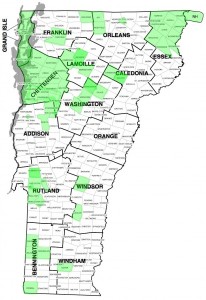
Where is Front Porch Forum available?
Front Porch Forum is available to anyone who lives in one of these Vermont towns [list UPDATED 02/23/2011]…
- Alburgh
- Arlington

- Averill
- Avery’s Gore
- Bloomfield
- Bolton
- Bridgewater
- Brighton/Village of Island Pond
- Bristol
- Brunswick
- Buells Gore
- Burlington
- Calais
- Cambridge
- Canaan/Village of Beecher Falls
- Castleton
- Charlotte
- Colchester
- Dover
- Duxbury
- Essex Junction Village
- Essex Town
- Fairfield
- Ferdinand
- Grand Isle
- Hardwick
- Hinesburg
- Hubbardton
- Huntington
- Isle La Motte
- Jay
- Jericho
- Johnson
- Lemington
- Lewis
- Ludlow
- Middlesex
- Middletown Springs
- Milton
- Moretown
- Morristown
- Newport City
- North Hero
- Norton
- Poultney
- Pownal
- Richford
- Richmond
- Sandgate
- Shelburne
- South Burlington
- South Hero
- St. George
- Starksboro
- Stewartstown, NH
- Stowe
- Sunderland
- Underhill
- Vergennes
- Walden
- Warner’s Grant
- Warren Gore
- Waterbury
- West Rutland
- Westfield
- Westford
- Williston
- Winooski
- Worcester
And we’re expanding to other areas in the coming months. Sign up or join our waitlist. FPF is free to local residents.
Contact us if you want to sponsor FPF’s launch in your town. Join our growing list of launch sponsors: Grand Isle County sponsors, Orton Family Foundation, e-Vermont, Town of Johnson, Johnson State College, Comcast, Lake Champlain Islands Chamber, Franklin County Caring Communities, Franklin Central Supervisory Union, City of St. Albans, Ben & Jerry’s Foundation, Revitalizing Waterbury, Town of Duxbury, Ben & Jerry’s Homemade, and others
Email ain’t dead (WSJ, you lunkhead)
Andy Schroepfer at Rackspace wrote recently about the future of email vs. social media, texting, etc. Some, like today’s nutty Wall Street Journal article, declare the demise and coming death of email. Oh, puh-lease. And we all have paper-less offices, and radio disappeared the day after TV arrived, and the U.S. Postal Service is closing up shop tomorrow. We definitely have a rapidly evolving communication and media landscape, but seldom do the stalwarts just disappear.
In fact, email dominates the field over the likes of Twitter, FaceBook, texting, RSS, etc. Email is the default. That’s why Front Porch Forum uses it as a primary distribution path… we’re trying to reach EVERYONE in a local community, not just one clique or another. Anyway… here’s an interesting bit of data from Forrester Research…

Social Change 2.0
I had the pleasure of introducing David Gershon’s work to Portland, Oregon more than a dozen years ago. So Mike Lindberg’s quote about David’s new book caught my eye…
“Social Change 2.0 exhilarates. David Gershon has not just laid out a compelling and coherent blueprint for social change, but the vividly written stories he shares make us realize that what we thought was impossible can actually be achieved. Having been a political leader in Portland for twenty years, where I worked closely with David, I saw firsthand the power of his work to change the lives of thousands of people. He may well be the number one expert on social change in our country.”
– Mike Lindberg, former Commissioner of Public Utilities and city council member, City of Portland, Oregon
David’s work has some interesting parallels to Front Porch Forum. I look forward to reading it. (Buy the book here.)
Reaching beyond social media’s “Big Three”
Inman News columnist Gahlord Dewald posted a piece today aimed at real estate professionals about how they might make the most of social media tools. This clip caught my eye…
… If you expand beyond the “Big Three” social media platforms of Facebook, Twitter and LinkedIn, you might find very specific platforms that align with your goals. For example, in Burlington, Vt., we have an awesome forum system called Front Porch Forum. This platform is highly targeted by neighborhood and operates via (wait for it …) e-mail.
Not what you might think of when you think super-new-cool technology. But FPF is a highly valued resource in our town. About 40 percent of the local population are members (and this is a college town). The neighbors talk about the neighborhood. Pretty relevant for a real estate professional.
Spending the time to locate active social media platforms that are topic-focused — to round out your me-focused Facebook-LinkedIn-Twitter participation — is a good idea…
Don’t feel like the b-word, danah
danah boyd’s post feels right on target… except for the “feeling like a bitch” part… fight the good fight, danah!
… I get hundreds of emails per day that I have to directly respond to. (Hundreds more get filtered into the “will read one day” folders that get very little attention.) I do a huge amount of my responding offline (on airplanes, public transit, cafes, etc.). Thus, messages with links take much longer to get my attention than messages without links. But there’s something nice about turning an INBOX into something manageable before people have the chance to respond. The problem with Web2.0 technologies is that each one wants to replace the INBOX (or at least be an additional channel). For example, there are private messages and comments on social network sites, direct messages and @replies on Twitter. There are blog comments. And RSS feeds. And then there are all of the online communities and bulletin boards and chat spaces that have evolved from those developed in olden days. For me, it’s too much. Too much I tell you. And we haven’t even gotten to voicemail, text messages. Let alone all that’s coming…
About Blog
Ghost of Midnight is an online journal about fostering community within neighborhoods, with a special focus on Front Porch Forum (FPF). My wife, Valerie, and I founded FPF in 2006... read more
Post Categories
- Uncategorized
- PDF2009
- Calendar
- podcast
- Northeast Kingdom
- Peer Rental
- Big Tech
- Localization
- Events
- Google AdSense
- Web Traffic
- PDF2007
- Elections
- Pay It Forward
- berkmansunlight
- Maps
- Video
- Upstate New York
- Mobile
- Coupons
- Wildlife
- Raffle
- Viral Marketing
- Donations
- Crisis Response
- Lost & Found
- Gratitude
- College Students
- Real Estate
- Social Responsibility
- Orton Family Foundation
- Start ups
- Make It Your Own Awards
- Online Civility
- Clay Shirky
- Newspapers
- Humor
- How To Use FPF
- Online Classified Ads
- Peer Reviews
- Politics
- Community Management
- Best of FPF
- Economic Development
- Local Reviews
- Case Foundation
- Borrow and Lend
- Neighborhood Watch
- Good Government
- Small Business Advertising
- Citizen Journalism
- e-Vermont
- Democracy
- Local Search
- Knight Foundation
- Burlington
- MacArthur Fellows
- Civic Engagement
- Social Media
- social capital
- Social Networking
- Vermont
- Neighborhood
- Community Building
- Local Online
- Front Porch Forum