Category Archives: Social Media
Challenging Conventional Web 2.0 Wisdom
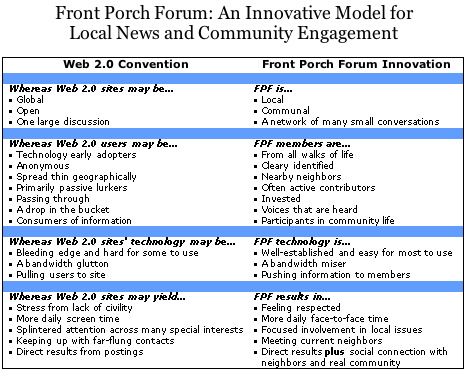
A friend jokingly refers to Front Porch Forum as the “anti-internet” and he got me thinking. I ended up with the chart below comparing conventional wisdom for much of “Web 2.0” vs. FPF.
FYI, Front Porch Forum hosts networks of online neighborhood forums that blanket metro areas. In our Chittenden County, VT, pilot, 11,000 households subscribe, including one-third of Burlington. People connect with neighbors and build community through the exchange of postings among clearly identified nearby neighbors.
So, Peter Kafka got me thinking more with his post on Silicon Alley Insider the other day, in particular this gem…
It’s counterintuitive, but during an up cycle people accept conventional wisdom, and during a down cycle people challenge it. That’s good. Very good. And the cycle will winnow competition.
Well… an upside to our economic crisis! A year ago during good times a few Web 2.0 experts took a look at Front Porch Forum and each, in his way, told us that we needed to get in line and look more like the left column above. And just in the past week I’ve heard from some folks in the same crowd and they’re showing up with open minds and probing questions.
Riding the adoption bell curve
A posting on TechCrunch came with this nifty illustration about adoption of new online services the other day…
… customers and word-of-mouth referrals travel from left to right along a bell curve that starts with Innovators and Early Adopters, peaks with the Early Majority and the Late Majority, and finally permeates with reaction from Laggards.
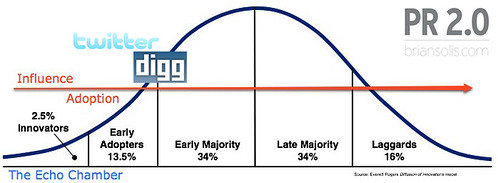
If I read this right, the author is claiming that Digg and Twitter have about 16% market penetration. In a previous posting here, it was noted that Digg has 30 million monthly visitors, with 3 million of them registered users. Considering just the U.S. population (300 million), wouldn’t that put Digg between 1% and 10% penetration? That is, still far from moving out of the Early Adopter range?
Nearly 20% of our pilot area subscribes to Front Porch Forum, including 33% of Burlington and better than 90% of our leading neighborhoods. That puts the bulk of our service in the Early Majority area, with our best neighborhoods pushing through the Late Majority and into the Laggards.
Web 2.0 for the rest of us?
reports today on CNET News…
LONDON–Digg founder Kevin Rose had a message for the audience at the Future of Web Apps conference on Thursday: It’s time to grow up.
“We have to do better,” he said in his talk, called “The Future of News,” and said that it’s time for the social news site that he founded in 2004 to to expand beyond the geek set and get some real-world relevance. “Why click a button and make the number go up by one? Why does that matter?”
Digg, after all, gets more than 30 million monthly visitors, but Rose said that the site only has slightly over three million registered user accounts–those are the people actually “Digging.” That indirectly confirmed what Digg critics hve been saying all along: that it’s reflective of only a tiny and vocal subset of the Web, resulting in a heavy bias toward anything iPhone, anything Linux, anything Barack Obama, and plenty of wacky local news stories.
I’ve been fortunate to speak to many groups over the past year or so, and I frequently survey each crowd about technology and services that they’ve (1) heard of, and (2) use. Routinely, only one or two hands will go up for Twitter, RSS, LinkedIn, Digg, Flickr, Delicious, etc. to my first question. But almost no one ever admits to using these tech media darlings. Meanwhile, it’s not unusual in talks with local groups within our pilot area to have half of the hands reaching for the ceiling when I ask about Front Porch Forum.
Kevin Rose’s call above seems on target to me. When you offer a service globally, it’s not outrageous to find a million tech professionals and hobbyists to jump on board. But try raising an online crowd within a local community… especially one that stays plugged in over time… very difficult.
In our pilot area, more than 11,000 households subscribe to Front Porch Forum, including one-third of Burlington, VT. We have people in their 80s using FPF. I spoke with a homeless person the other day who’s on board. College students love FPF. And we have droves of non-techie grown-ups… folks who are too busy with their lives to look into why they should tweet or digg. Busy or not, they do know that Front Porch Forum is the place to turn to borrow a couple saw horses, find a babysitter, recommend a roofer, learn about a rash of break-ins, give away their couch, buy a bike, hear from their school board member about the budget, etc.
I’m looking forward to more online offerings aimed at the rest of us… not just the heavy tech consumers. Of course, it’s tough for the traditional and new media, as well as funders, not to be dazzled by shiny bells and whistles, especially when these sites attract a sizable group of early adopters from the global masses. This top-down approach has worked incredibly well for Google and a host of others. And it will continue to draw most of the media spotlight and funding.
I’m eager to see more efforts coming from the other direction — the grassroots on up and out — such as we’re doing with Front Porch Forum… the Craigslist and Angieslist approach. That is, get traction in one metro area, then spread to others.
New Media Guru in Vermont Oct. 4
New media thinker and do-er Dan Gillmor will speak at the UVM Center for Rural Studies 30th anniversary bash on October 4, 2008 starting at 5:00 PM. I’ve been fortunate to hear Dan speak and follow his online writing for the past couple years… great stuff. And now he’s leading the newly formed Knight Center for Digital Media Entrepreneurship at Arizona State University’s Walter Cronkite School of Journalism and Mass Communication.
Front Porch Forum is tickled pink to be involved (albeit in a small way). Come to the conference all day… or at least catch Dan’s talk at 5:00 PM and the panel he’ll moderate after that.
-Author of We the Media: Grassroots Journalism By the People, For the People (2004; O’Reilly Media)
-Director of the Knight Center for Digital Media Entrepreneurship at Arizona State University’s Walter Cronkite School of Journalism and Mass Communication
-Director of the Center for Citizen MediaAt the newly created Knight Center for Digital Media Entrepreneurship, Dan Gillmor is working to help create a culture of innovation and risk-taking in journalism education, and in the wider media world. He is founder and current director of the Center for Citizen Media and previously founded Grassroots Media, Inc. From 1994-2004, Gillmor was a columnist at the San Jose Mercury News, Silicon Valley’s daily newspaper, and wrote a weblog for SiliconValley.com. He joined the Mercury News after six years with the Detroit Free Press. Before that, he was with the Kansas City Times and several newspapers in Vermont. A Phi Beta Kappa graduate of the University of Vermont (’81), Gillmor received a Herbert Davenport fellowship in 1982 for economics and business reporting at the University of Missouri School of Journalism. During the 1986-87 academic year he was a journalism fellow at the University of Michigan in Ann Arbor, where he studied history, political theory and economics. He has won or shared in several regional and national journalism awards. Before becoming a journalist he played music professionally for seven years.
And I seem to recall some former Vermont professional connection of his. Hmm…
PBS offers Examples of New Media aiding Local Communities
Mark Glaser, New Media Expert for PBS, offers examples of the internet serving local communities…
That’s heady company for FPF… two nationally known Knight Foundation grant recipients. Everyblock and Spot.Us are both exciting projects. See Mark’s comments for yourself…
Place Blog Data from New York Times
Bob Tedeschi wrote in the New York Times (Aug. 10, 2008) about local news blogs and included some interesting data…
Baristanet.com [Montclair, N.J., and surrounding towns]:
- Posts about five or six videos, articles or photos every weekday.
- Debuted in early 2004 and now attracts 18,000 readers on peak days… and more than 82,000 monthly readers, or roughly twice the population of Montclair, and about three times the number of readers it had early last year.
- The site has a full-time editor, Annette Batson, a full-time designer, and four part-time workers, [and] now consistently generates more than $10,000 in monthly profits.
Red Bank Green (www.redbankgreen.com) [Newark, NJ], started in 2006… attracts about 45,000 readers a month.
Hoboken411.com [Hoboken, NJ]… attracts more than 250,000 monthly visitors… readers click on “several million” pages monthly on his blog, founded in 2006, and have added more than 100,000 comments.
WestportNow.com [Westport, CT] started in 2003, has more than 40,000 monthly readers.
NewHavenIndependent.com [New Haven, CT], begun in 2005… has three full-time reporters and one part-time reporter, all paid for by $185,000 in grants, corporate sponsorships and private donations.
The Loop (GetInLoop.com) [Long Island, NY], a new hyperlocal site started last year… attracts more than 10,000 monthly visitors.
Launched in 2006, Front Porch Forum is a different model, but shares some things in common with these efforts. Our 10,000 subscribing households are local to our pilot area (greater Burlington, VT) and are about 20% of total households. These good folks supply nearly all of the writing (FPF employs no writers) and partake of our service every other day on average.
Hometown Daily Covers Front Porch Forum
Thanks to Sally Pollak who wrote an excellent feature article about Front Porch Forum for the Burlington Free Press yesterday.
Photo credit: Alison Redlich, Free Press
About Blog
Ghost of Midnight is an online journal about fostering community within neighborhoods, with a special focus on Front Porch Forum (FPF). My wife, Valerie, and I founded FPF in 2006... read more
Post Categories
- Uncategorized
- PDF2009
- Calendar
- podcast
- Northeast Kingdom
- Peer Rental
- Big Tech
- Localization
- Events
- Google AdSense
- Web Traffic
- PDF2007
- Elections
- Pay It Forward
- berkmansunlight
- Maps
- Video
- Upstate New York
- Mobile
- Coupons
- Wildlife
- Raffle
- Viral Marketing
- Donations
- Crisis Response
- Lost & Found
- Gratitude
- College Students
- Real Estate
- Social Responsibility
- Orton Family Foundation
- Start ups
- Make It Your Own Awards
- Online Civility
- Clay Shirky
- Newspapers
- Humor
- How To Use FPF
- Online Classified Ads
- Peer Reviews
- Politics
- Community Management
- Best of FPF
- Economic Development
- Local Reviews
- Case Foundation
- Borrow and Lend
- Neighborhood Watch
- Good Government
- Small Business Advertising
- Citizen Journalism
- e-Vermont
- Democracy
- Local Search
- Knight Foundation
- Burlington
- MacArthur Fellows
- Civic Engagement
- Social Media
- social capital
- Social Networking
- Vermont
- Neighborhood
- Community Building
- Local Online
- Front Porch Forum