Category Archives: Community Building
Cities, neighborhoods, community and Jane Jacobs
Convergence from my reading pile…
- Richard Florida: Who’s Your City: How the creative economy is making where to live the most important decision of your life, 2008.
- Jonah Lehrer, NYTimes Magazine, A Physicist Solves the City, Dec. 19, 2010.
- John McKnight and Peter Block: The Abundant Community: Awakening the Power of Families and Neighborhoods, 2010.
Each author talks about cities and neighborhoods, and residents’ decisions about where to live and how to live within their communities. They all reference Jane Jacob‘s pioneering work in community and urban planning. And each is well worth reading.
The Times article examines the research of Geoffrey West who is developing equations that he claims describe cities… parallel to the laws of physics. E.g., “whenever a city doubles in size, every measure of economic activity… increases by 15 percent per capita.” Which leads to the idea that moving a person to bigger and bigger cities will make her more and more economically productive.
Richard Florida’s book is full of interesting survey data. Take a look at his maps. Here’s a sample…

Finally, the most compelling and visionary of the lot to this reader is The Abundant Community. McKnight and Block, from a lifetime of experience lay out their case for “a new possibility for each of us to live a more satisfying life” by joining “our neighbors to live and create a community that nurtures our family and makes us useful citizens.” Lots of tactics and examples placed in a useful framework. Many neighborhoods and rural towns in Vermont are using Front Porch Forum in this way and it’s beautiful to behold.
No more nasty anonymous newspaper comments…
Glad to see this move by the Sun Journal is western Maine…
The obligation to stand behind your words has also been a core principle of journalism and this newspaper for many years.
The Sun Journal does not use unidentified sources in stories. When our readers write a column or letter to the editor for the newspaper they use their real names.
That, we believe, makes them accountable for what they say, plus it adds weight and credibility to their words.
But we have deviated from that principle for the Web, believing for several years that “online” was somehow different than “in print.” Nearly all newspapers have.
While we have known the identity of many people commenting on stories at sunjournal.com, it was difficult or impossible for users to know. As a result, some comments have been factually incorrect, reckless and mean-spirited.
While the technology of the Web is very different, our core principles should remain the same.
Both our website and print newspaper are, in fact, like a town meeting or community gathering.
So, beginning Feb. 1 all online comments at sunjournal.com will be accompanied by the real names of the people commenting. Only registered and verified users will be able to make comments. Anonymous comments will not be allowed.
All commenters, including subscribers and those registered now, will have to re-register under the new system.
Many newspapers, including the Portland Press Herald and the Bangor Daily News, are now taking steps to make Web commenting more responsible and accountable.
But our new system is the most ambitious effort we’ve seen to elevate the level of online discussion.
Plus, most of our current commenters seem to agree. In an online survey, 57 percent said they would prefer that real names accompany online comments.
The Sun Journal’s motto is “Connecting you with your community,” and for more than 160 years this newspaper has knit together Western Maine communities.
The advent of the Web has given us powerful new ways to connect people and allow anyone to become an active part of every discussion.
We know this decision will not please everyone. In time, however, we believe it will result in a better online experience for all.
New study: Walkable communities are more socially engaged
From USAToday, report of a new study… people who live in walkable communities enjoy greater social capital than their car-bound fellow citizens. Not too big of a surprise here… common sense. Also, we’ve seen Front Porch Forum lead to increased social capital and one typical outcome is that nearby neighbors talk more face-to-face once FPF catches on. It’s hard to connect with neighbors when you can’t easily see or talk to them.
People who live in walkable communities are more socially engaged and trusting than those who live in less walkable areas, says a new study from the University of New Hampshire.
The study buttresses other research that has linked a neighborhood’s walkability to its residents’ quality of life, notably improved physical and mental health.
The researchers scored 700 residents of three communities in New Hampshire on measures of “social capital” such as socializing with friends, civic engagement and trust in their community. They found those in neighborhoods with higher Walk Score ratings reported being happier and healthier and more apt to volunteer, work on community projects or simply entertain friends at home.
“In the age of increasing energy costs and climate considerations, the ability to walk to important locations is a key component of sustainable communities,” write Shannon Rogers and the co-authors of the study, published online in the journal Applied Research in Quality of Life.
If the residents of these walkable neighborhoods are homeowners, they benefit in yet another way, notes the Sierra Club’s Green Life blog. It cites a 2009 study by CEOs for Cities that founds homes with an above-average Walk Score sold for up to $34,000 more than their sidewalk-less counterparts.
Grand Isle Co. + FPF = iPod?
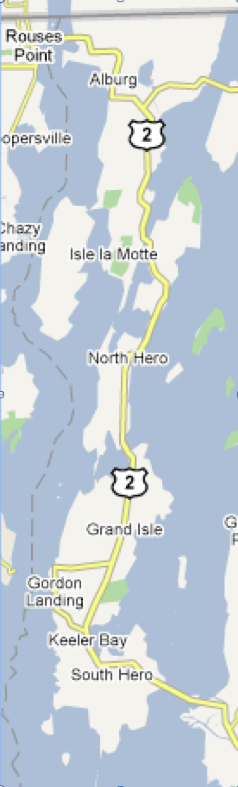 Do you know someone who lives in Grand Isle County, #VT… or spends significant time on the Islands? If yes, then please share this…
Join your Grand Isle County neighbors at FrontPorchForum.com and win an iPod!
Sign up today for your town’s e-newsletter: Front Porch Forum. If you live in The Islands you’ll be entered to win an iPod shuffle!
Front Porch Forum is building community in the Islands by helping neighbors connect. Need a babysitter, electrician, or snow plow guy? Just type a quick message and it goes out to your neighbors. Want people to attend an event, or know about a break-in? FPF is a great way to get the word out.
It’s easy to sign up… just go to FrontPorchForum.com and fill out a quick form. Then start reading and posting!
Do it soon! Only new sign-ups received by December 31, 2010 will be eligible to win the iPod shuffle. Sign up at: FrontPorchForum.com
Sample messages:
- Group rate for fuel oil
- Seeking reliable plumber
- Break-in report
- Free bookcase and table
- Childcare available
- Keys found
- Community supper in the works
- School board member responds
- Casseroles for sick neighbor
Front Porch Forum is available across 50 Vermont towns, now including all of Grand Isle County. Thanks to the e-Vermont initiative for sponsoring FPF in The Islands.
Average U.S. Adult Investing 19% of Life in…
Wow. This is depressing. Screen time is on the rise among American adults. From eMarketer…

That’s about 4.5 hours of TV time for the average adult? What could we possibly be watching that’s worth 19% of our remaining time on Earth?
And only 2.5 hours on the internet? Well… full disclosure… I’m way over that amount… as are loads of my peers. I wonder what the Internet data range looks like… lots of zeros on one end and 8-10 hour/day people on the other perhaps.
And a big jump in brain-cancer-sticks/cell phones… almost an hour/day. We are a chatty species. I wonder what percentage of mobile use is inane… compared to other media use? Maybe it’s similar… but I just don’t have to be aware of what the person next to me in the store is watching on TV or surfing on the Internet. And why don’t we see landline use in this kind of analysis? Or books? No advertising opportunity, I guess, is the short answer… therefore not media?
One more thought… most of this media consumption (despite social media, most of these media hours I’d guess are still primarily passive and consumptive) can occur at many workplaces… mobile, internet, radio, etc. But not TV. So, if the average adult is spending 4.5 hours after the workday watching TV… sheesh… no wonder this country is struggling.
A quick cobble of internet-sourced data (here and here) shows how we U.S. adults are spending our remaining days of life…
33% Sleeping
31% Working
19% Watching TV
5% Caring for others
4% Eating
2% Commuting
5% Other stuff… perhaps even including local community involvement
TV is robbing the places where we live of people-hours… of capacity to get things done… of the chance to even get to know each other and live in community.
This is where Front Porch Forum comes in. We aim to help neighbors connect and get tuned in to local goings on. FPF seeks a few minutes every day or so of members’ attention to focus on the people and issues right around them. In doing so, FPF members report feeling more a part of the place they live, more connected… and, eventually, more involved. I wonder if FPF membership might even help steal some of those 4.5 hours a day away from the cathode ray nipple (LCD nipple?) and return them from whence they came… to our nation’s neighborhoods, clubs, churches, schools, parks, pubs, town halls, polling places, and other gathering spots.
Duping by the crowd vs. building community among neighbors
Greg Sterling blogged today (in part)…
The Sunday Times in the UK writes that Yell employees wrote 6,700 reviews for the site (TrustedPlaces) in a month for an internal contest. According to secondary reports:
Staff at the firm’s Reading HQ were encouraged to write reviews for the company’s website Trusted Places – a site boasting user-generated recommendations of places to visit – by the offer of prizes such as an iPad and Amazon vouchers, according to the Sunday Times.
The article and information are presented as something of an expose or scandal. However I don’t necessarily agree. If the reviews are real and authentic they’re not illegitimate in my mind. But it’s a close call…
Well… I’m not sure how 6,700 reviews written by paid staff for some kind of internal contest could be considered “real and authentic.” More importantly, this fuels a not uncommon suspicion that many online reviews are B.S. It’s just too easy to stack the deck with reviews from people who have a stake in the business being reviewed or in the host site itself.
We often hear from people who place a high value on reviews read on Front Porch Forum. They use terms like “real” and “authentic” because that’s what they are… postings from clearly identified nearby neighbors typically offered in response to a request from a neighbor… “can anyone recommend a good plumber?”
Also, each recommendation is seen by everyone in the neighborhood, not just those few who happen to be searching for a plumber. This leads to conversation among neighbors… sometimes on FPF, often via email, and even more commonly face-to-face.
So… a huge database of potentially bogus reviews from strangers… vs. a few reviews from clearly identified nearby neighbors that lead to conversations among neighbors on the sidewalk. Two different propositions.
Feelings lead to action
Richard Millington’s post today got me thinking…
Feelings provoke actions… Focus on making members feel more engaged, not act more engaged.
Many times a day, Front Porch Forum pilot members are moved to be more engaged in FPF… and, more importantly, many are move to be more engaged in their actual/non-virtual neighborhood. This is often brought about by feelings elicited by an FPF posting from a neighbor.
Here are two key references from Millington…
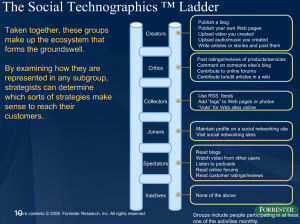
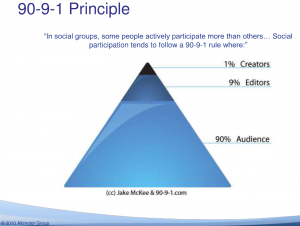
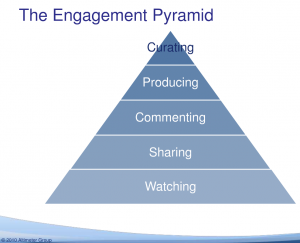
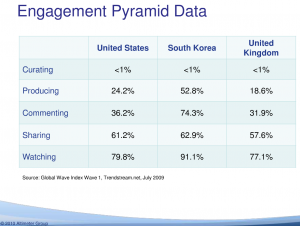
You’ve probably come across the technographics ladder or the socialgraphics engagement pyramid. These categorize members by their actions. Lurkers are at the bottom, creators at the top. Sharing, reading, tagging are in-between.
First, the technographics ladder…
And the socialgraphics engagement pyramid…
Our mutual aid muscles are out of shape and pretty flabby
From Sarah Byrnes in YES! Magazine…
If there’s anything I’ve learned while helping to organize Common Security Clubs in communities around the nation, it’s that there is no “one size fits all” club. They are as different as the individuals who comprise them.
But a common thread is that clubs provide a way for people get to know each other. It’s an old-fashioned concept—knowing your community—but it’s badly needed in our time of increasing insecurity and isolation.
“We usually spend about 45 minutes on a ‘check-in’ with each other,” says Paul Miller in Boston, whose club has been meeting for two years. “The focus is simply on hearing each other, and providing support whenever possible. People get to air their concerns and receive affirmation.”
“We’re taking baby steps toward a new type of community,” adds Jared Gardner, a facilitator in Portland, Oregon. “We want people to feel connected and empowered. That’s what the groups are all about.”
In the past, neighbors knew each other and engaged more naturally in mutual aid, sharing common resources and helping those in need. Nowadays, our mutual aid muscles are out of shape and pretty flabby. Clubs help us to start flexing and stretching them again, little by little.
New study: Neighborhood websites build community and get people involved
Congratulations to UK’s Hugh Flouch and Kevin Harris on the publication of the results of their new study…
Do neighbourhood websites have a positive social impact locally? For those who’ve suspected and long wanted convincing evidence, we think the wait is over.
The report of the Online neighbourhood networks study was launched yesterday during a lively conference in London…
Our study looked at three neighbourhood sites in London. The research shows that they serve to enhance the sense of belonging, democratic influence, neighbourliness and involvement in their area. Participants claim more positive attitudes towards public agencies where representatives of those agencies are engaging online.
We’ve produced a short (4-page) summary, an extended summary, a full report divided into digestible chunks, a selection of video interviews, together a number of other papers, and we will continue to add to these.
We see similar trends with Front Porch Forum in our pilot region. That is, FPF members report… (1) better connection to neighbors and neighborhood, (2) a more prominent voice in local decision-making, (3) a friendlier environment, and (4) increased civic engagement.
Miscellaneous findings from the UK report…
95% – Feel more informed about neighborhood
92% – Neighbors are helpful if asked for advice
69% – Increased sense of belonging within neighborhood
92% – Useful information gets shared efficiently
82% – People pull together to improve neighborhood
63% – Main source of local news
44% – Neighbors more likely to lend items or exchange favors
42% – Met a neighbor
54% – More likely to see a neighbor you recognize due to website – Active member
14% – More likely to see a neighbor you recognize due to website – Passive member
This collection of materials is worth a close look!
About Blog
Ghost of Midnight is an online journal about fostering community within neighborhoods, with a special focus on Front Porch Forum (FPF). My wife, Valerie, and I founded FPF in 2006... read more
Post Categories
- Uncategorized
- PDF2009
- Calendar
- podcast
- Northeast Kingdom
- Peer Rental
- Big Tech
- Localization
- Events
- Google AdSense
- Web Traffic
- PDF2007
- Elections
- Pay It Forward
- berkmansunlight
- Maps
- Video
- Upstate New York
- Mobile
- Coupons
- Wildlife
- Raffle
- Viral Marketing
- Donations
- Crisis Response
- Lost & Found
- Gratitude
- College Students
- Real Estate
- Social Responsibility
- Orton Family Foundation
- Start ups
- Make It Your Own Awards
- Online Civility
- Clay Shirky
- Newspapers
- Humor
- How To Use FPF
- Online Classified Ads
- Peer Reviews
- Politics
- Community Management
- Best of FPF
- Economic Development
- Local Reviews
- Case Foundation
- Borrow and Lend
- Neighborhood Watch
- Good Government
- Small Business Advertising
- Citizen Journalism
- e-Vermont
- Democracy
- Local Search
- Knight Foundation
- Burlington
- MacArthur Fellows
- Civic Engagement
- Social Media
- social capital
- Social Networking
- Vermont
- Neighborhood
- Community Building
- Local Online
- Front Porch Forum